
Kristin Scott Thomas is one of those performers I’m surprised I haven’t already written about during coverage of a past TIFF, some year when she had a couple of films at play. I certainly count myself as a real fan of her acting. There’s something a bit dry in her delivery, but you won’t miss the warmth or humor underneath.
She’s a marvel to me too, because I thought after her first film role – in Prince’s ‘Under the Cherry Moon’ as the spoiled rich brat his musical gigolo falls for – she might not ever work again. The movie is a guilty pleasure, since I’m an unabashed Prince acolyte, but let’s say, the movie failed to earn even B-side cred.
Yet, Thomas found her footing and then some in crowd-pleasing fare like ‘Four Weddings and a Funeral,’ quietly vamping it up in ‘Richard III,’ and then scoring a Best Actress Academy Award nomination for ‘The English Patient.’ It was much more recently that I felt she had truly transitioned into the esteemed leading lady category with 2008’s ‘I’ve Loved You So Long,’ which offered her a mature role worthy of both her talent and our appreciation. Going completely against type as a woman returning her family and a fight to find a place for herself after serving a 15-year prison sentence, the film never fell prey to the wild histrionics we might have expected. She guided us through a largely internalized portrait of staggering heartbreak.
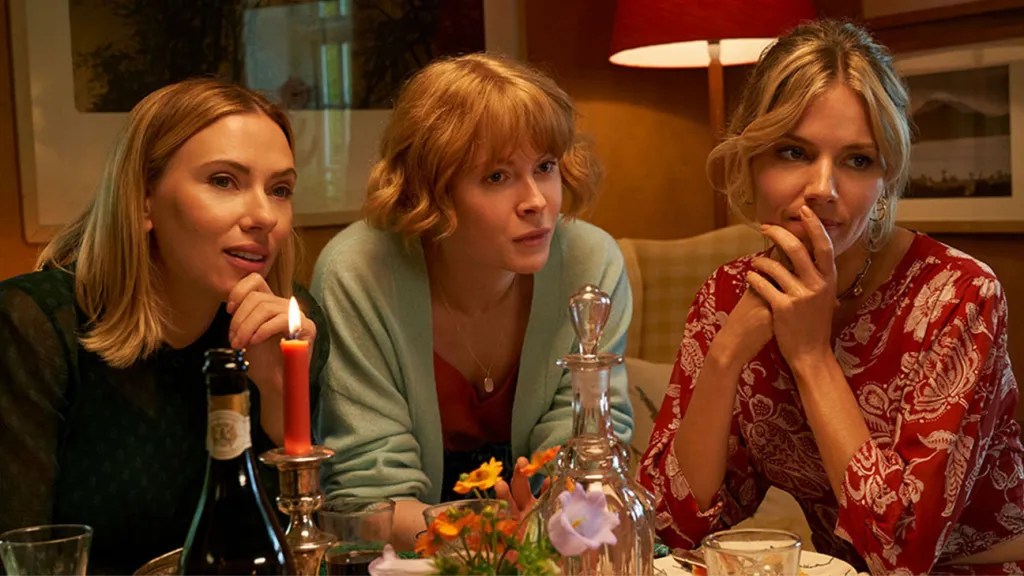
And yet, here I am, finally, shining my TIFF spotlight on her, more for her directorial debut. She has a supporting role in ‘North Star,’ as the mother of three daughters – played by Emily Beecham, Scarlett Johansson, and Sienna Miller – on the verge of marrying for the third time, while her children face their own relationship issues. Thomas, besides helming and co-starring, also co-wrote the script with John Micklethwait and it has the feel of an intimate study of complicated family dynamics. Her three daughters sprang from marriages to two men – best friends, in fact – who gave their lives in the service of their country. Her two older children have memories of their father, but felt a strong bond with their stepfather.
It is in the exploration of these somewhat fractured parental concerns that the film speaks most profoundly to me. How we express allegiance to the memories of a father (from holding onto names to following in their career footsteps) drives and animates things moreso than any particular decision Thomas makes as director. I am personally fascinated with fatherhood and stepping in as a parent through marriage, and Thomas pays tribute to her own two fathers in the closing credits. She is showing us who we are, especially through simple animated sequences from the perspective of Johansson’s eldest daughter who was forced to make the choice to keep her father’s name after a request from her stepfather right before his own tragic military death.
I was so intrigued by these concerns that, to be honest, I probably had a much stronger positive reaction to the narrative than I might have otherwise. There is nothing in the direction that dramatically impacts my sense of emotional engagement, or necessarily in the writing per se. But all of the main performances sing, in their own keys, creating a harmonious and quite beautiful melody that feels straight out of the playbook of Thomas. While she may grow into even more of an actor’s director down the road, I would argue what ‘North Star’ proves is Thomas might be an emerging director of character, which is quite a compliment.
 terrencetodd