
Tags
In the Marvel Comic Book world, the character is routinely called “The Man Without Fear,” but the tagline never crops up in a single one of the 13-episodes of the Netflix series. Intriguingly, blind lawyer Matt Murdock (Charlie Cox) doesn’t even earn a moniker for his crime fighting alter ego until the final chapter in this novelistic origin story. And just as fitting, his nemesis Wilson Fisk (Vincent D’Onofrio) is never referred to by his own underground name (The Kingpin). In fact, during much of the early part of the series, most of the other players hardly ever dare to utter the man’s given (Christian) name.
Names, whether whispered or shouted from the rooftops, the story seems to imply, bear the stain and stench of fear. To be honest though, just about every aspect of the series, starting with its gritty Hell’s Kitchen setting, comes cloaked in the alternately hot and cold shroud of fear. Citizens are afraid of the criminal element threatening to overrun the city. The criminals look over their shoulders as they engage in their dark transactions, constantly suspicious of rivals and dirty cops. Characters fear being lost or left alone.
And, on top of all that, Hell’s Kitchen and the greater City now have to worry about attacks from beyond our world. Aliens, god-like figures with magic hammers, men and women with super or extra-ordinary powers are out there, capable of leveling city blocks in a matter of minutes, leaving all kinds of waste and destruction in their wake. People fear that kind of power, although there’s so little that can be done, or said, about it.
That is where Marvel’s Daredevil begins, but again, as with the names of characters, no one directly addresses “the incident” – you know, the battle between the Avengers and Loki’s cannon fodder allies The Chitauri. The City and its citizens just set themselves to the task of cleaning up and moving on.
There is much to love in this narrative approach. Marvel’s pact with Netflix, which guarantees a quartet of solo street-level heroes (Daredevil, Jessica Jones, Luke Cage and Iron Fist) who will eventually come together to form the decidedly more earthbound team The Defenders, promises figures that are indeed part of the larger shared universe that includes the big-screen super beings as well as a bridge with the world’s episodic brethren (Marvel’s Agents of SHIELD) on network television.
From the time of the initial announcement though, I have been fascinated by the potential of cross-platforming these stories. And I am in awe of the realization of those aims in Daredevil, which has now catapulted to the top of my list, in terms of Marvel’s filmed content thus far. The series is easily the richest and most accomplished bit of storytelling in the shared universe, and it speaks to an expert use of the medium. Film offers the opportunity to portray grand myths in high relief, full of CGI spectacle and the stuff of dreams. You want to see Hulk and Thor trade blows and then team up to take on a horde of anonymous aliens or robots, then look no further than your nearest multiplex. When you’re ready to shift gears and track the adventures of a ragtag collection of human agents trained to deal with the occasional extraordinary being, while engaging in a soapy personal matter or two, sit down for an hour’s worth of Agents of SHIELD.
But those pleasures are worlds apart from the ones to be found in Daredevil. First off, the world of Daredevil is as close to what we (as the audience) might imagine, if superheroes truly did exist. They would zip around us, doing their thing, smashing buildings and evil plans in-between caffeine breaks. We might capture a glimpse of them during their down time in the City, much like we spy famous actors walking around Central Park or grabbing a bite to eat at their favorite top-shelf restaurants.
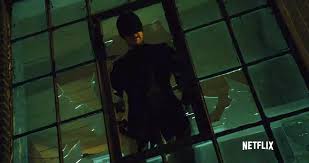
Charlie Cox as ‘Daredevil’
On a deeper, more critical level though, Daredevil resides in a space where Hell’s Kitchen drifts close to realization of Baltimore that we get in the HBO series The Wire. I know that’s a bold claim, one that cannot even dream of achieving that exalted status, but Daredevil traffics in the human drama of its disparate characters, the lowly lawyers Murdock and Foggy Nelson (Elden Henson), a host of cops – some bent into irredeemable crooks, others either rookies to be had or veterans who might live long enough to become wily – scared and scarred victims like Karen Page (Deborah Ann Woll) who join the good fight, and even a journalist like Ben Urich (Vondie Curtis-Hall), a crusader struggling to remain on the path while dealing with deeply personal concerns. And notice, in that rundown, I completely left out Wilson Fisk, the nefarious underworld figure, longing to change and rebuild the old neighborhood and his own status with a sense of righteousness that rivals the best intentions out there.
Daredevil spends the requisite and necessary time with these characters, allowing their individual needs and desires to rise to the fore and into conflict with those of others. It is this weaving and stitching of the narrative threads that makes the Netflix connection so obvious and important. It would be impossible to wait for weekly installments of these human dramas to play out over the course of 13, or a more likely 20-26 episode season that network television would demand. For a comparative point, while I am a fan of the ABC series Marvel’s Agents of SHIELD, I cannot honestly say I would ever want to binge watch the series. It works in its simple weekly episode format, much like the inherent charms in reading single issues of comics, but fiending for graphic novel collections of multi-arc stories. Plus, such drama leads to conflict that pushes the boundaries of acceptability. Netflix insures that any potential violence or sexuality can be rendered realistically without succumbing to the temptation to needlessly cross the line.
Continuing along the critical line, it is also a joy to watch a series that exercises the freedom to draw from the best of both film and television. It is no surprise that Matt Murdock’s journey to becoming The Man Without Fear mimics and mirrors the beats found in Batman Begins and The Dark Knight (from DC) and to a lesser extent, even those of Sam Raimi’s Spider-Man (great power and responsibility). What feels truly revolutionary though are countless hints to films like The Usual Suspects (Fisk as Keyser Soze), Unbreakable (the account of Murdock’s initial efforts at crimefighting), The Bourne Identity (Daredevil at one point ends up floating in the water similar to Jason Bourne), and The Untouchables (the plan to take down Fisk).
Daredevil creates a world teeming with reference and portent, of past traumas and future heartaches for all parties, but it is a world made for the living, and living in (as only bingeing allows). Such an achievement is worth the risk and the fear of expectation. (tt stern-enzi)
 terrencetodd