
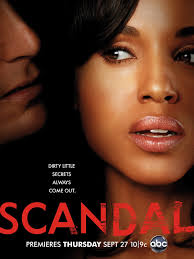
This week finds me in a bit of a funk, a new one for me, but not all that unfamiliar to all the watchers out there who have embraced the great big world of streaming narratives, especially the free kind. My wife and I just engaged in our first joint Netflix binge-watching frenzy, plowing through three seasons of Scandal. I can’t say I blinked much at all over the process, but I’m far more attuned to such bursts of narrative consumption. There’s not all that much difference between streaming and the visual downloading of an entire season or series via DVDs. For my wife though, the experience was eye-opening, which means that indirectly, I was fascinated as well. I watched her/us alter our schedules, change plans with friends, settle in far earlier than normal on weekends, so that we could immerse ourselves in this story, and we did so without an true awareness of how much of it lay ahead for us. We didn’t sneak peeks into the future to determine how many episodes per season (no scanning the table of contents for us to find out how many overall chapters there were in the latest epic novel in our laps). So, imagine our surprise when, just like that, we hit the end of season three, and found ourselves behind by only the currently unspooling fall season (and in the midst of the winter break, no less). The problem, of course, is that we would either have to pay for another streaming service to watch what we’ve missed thus far, or wait until the full-end run of season four, and then binge away on Netflix, months from now. In theory, I like the second option best. It has been fun sharing this (not so) secret time with her. It is our time. But I wonder if she can wait.
I can because, in between time, I do what I must. I work, which means I watch other narratives. The samples offered for consideration here cross fall the formats. Film, DVD, and streaming. What they also do, is slip past my defenses, these not so great (yet not quite guilty) pleasures that I pass off as work. As always I watch, searching for some reflection in those flickering flames that might help me to see myself a bit more clearly.
On film, I thrill this week over the idea of a new Wachowskis movie. Yes, I said thrill, but maybe what I mean is I surrender to the visual thrills they never fail to provide, while I also end up pondering the philosophically-bent narrative tease they sprinkle throughout. Jupiter Ascending, an original effort following their recent adaptive forays (Cloud Atlas, Speed Racer), since The Matrix trilogy, is a space-age fantasy adventure, over-stuffed with ideas and images and references – everything from the latest iteration of “The One” mixed with re-incarnation and genetics, universal plundering of ancient mythologies, monsters straight out of the Star Wars cantina, figure-skater and spaceship chases across the Chicago skyline at sunset, vampirism, love, love, and more love (inter-species and inter-genetic breeding that borders on the incestuous), Channing Tatum, and Mila Kunis – that dares to speak to the inner 13-year old geek in all of us (or at least those of us who had a 13-year old geek in them in the first place). I watched with wide-eyed wonder. I did. I wasn’t bored. I didn’t try to over-think the plot, because I knew that as soon as I did, the spell would be irrevocably broken, and I would wake up with my middle-aged sensibilities on full alert to the preposterousness of the beautifully rendered chaos onscreen. If you can, close off the adult mind and enjoy the thrill ride that only the Wachowskis can provide. They are, in some ways, like James Cameron; weavers of grand visions on the grandest of canvases, lovers of science and philosophy and design. They are too good for us, and this boring old real world of ours. If only we could live in their reels.
I am pummeled to a puny pulp by the sheer number of DVDs that arrive on my doorstep. They appear, like Agent Smiths in The Matrix Reloaded, ready to take me down, while I seek to swat them back with relaxed Neo-precision. But remember, for all his limit-testing, Neo couldn’t overcome the multitudes. This is my takeaway from that marvelous Wachowskis interlude. So, I’m here to report of Big Driver, adapted from a Stephen King story with a teleplay by Richard Christian Matheson (who knows a thing or two about translating King stories thanks to his work on “Battleground” from 2006 TV mini-series Nightmares and Dreamscapes based on the writer’s short fiction collection) and direction from Mikael Salomon. You know this is King territory, less for the supernatural element (which is absent this time out) than for its focus on a writer-in-distress. Tess Thorne (Maria Bello) faces a challenging road test when she faces off against a serial rapist/killer on a lone back trail while returning from a book signing. The intriguing aspect here is that Salomon doesn’t shy away from the assault and abuse that Tess endures. Her strength is personified through a pair of helpful voices – one belonging to the primary protagonist of her bestselling detective series and the other happens to be her GPS. For all the trauma she confronts, there is something at once humorous and yet somehow grounding in these two purely psychologically rooted guides, and Bello does her level-best to convince us that these manifestations are real. The unfortunate downside though is that the story never quite takes off like Misery, which is the high-water mark for this kind of King adaptation. The combination of menace and dependency was perfectly played, whereas, in this case, Big Driver traffics in lurid gallows humor, and a too-pat happy ending.
The savior lurking in my DVD pile happens to be Justin Simien’s Dear White People, and the timing couldn’t be better. The film made quite a splash straight out of Sundance last year when Simien claimed the festival’s Special Jury Award for Breakthrough Talent. I would refer readers to the more extensive piece I wrote on the film during its theatrical run (Critical Remix: ‘Dear White People’ v ‘Plantation Lullabies’), but the focus now, with the DVD release, is on the Special Features, in particular the PSA series: “The More You Know About Black People” and the “Racial Insurance” parody that appropriates elements from the State Farm commercials (the “Like a Good Neighbor” agent rescues) that still maintain a fairly heavy rotational spot. The genius of Simien was in creating a world beyond the filmed narrative that not only invited the audience in, but was the kind of place, some of us might want to reside in on a more permanent basis.
Finally, I tapped into Meet My Valentine, a VOD release that drops on February 7th, a mere week before Valentine’s Day. From director Brian Herzlinger (My Date With Drew), the heartfelt story tracks a successful painter/writer (Scott Wolf) married to a beautiful caterer (Courtney Ford) who discovers that he has an inoperable brain tumor and less than a year to live. He hatches a mad scheme to select his replacement, the kind of man he would want to take care of his wife and young daughter. With plot points that are normally played for rom-com laughs, Meet My Valentine, while utterly predictable, presses buttons in a critic like myself, a man of a certain age (the early stages of middle age) with a family of my own. It doesn’t naturally create a sentimental mood for me, but I can appreciate the desires of the protagonist and so, I’m more inclined to walk away with the feel good vibe of celebrating the treasures of life while you can. I just wish it didn’t have to be such a dumb-headed downer about its business.
I’m still investigating ways to meet my valentine over the first few episodes of the fourth season of Scandal and a bottle of wine. (tt stern-enzi)
 terrencetodd