
THOU WAST MILD & LOVELY – Trailer from Cinelicious Pics on Vimeo.
Staring at the title for this entry, I’m wondering if instead I should have gone with “Josephine Decker’s Perverse Beauty,” and I can tell, dear reader that the distinction, at this moment, is likely lost on you because you haven’t seen either Butter on the Latch or Thou Wast Mild and Lovely, the two features from this former actress and editor with a penchant for the kind of brutal honest that takes a scalpel to the skin, removing the outer layers and leaving all that lies beneath wet, raw, and exposed. The perversity, from what I have described, is obvious, but it would be a shame to focus on that aspect and to neglect the startling and unnerving beauty of the perfect form that stands before us, alive in ways that we cannot imagine, more naked than we would dare, even with our closest and most intimate partners.
I approached the double feature offered to me, on the eve of the New York screening of Thou Wast Mild and Lovely (and its same day VOD release) unfamiliar with Decker’s work, which is a rare treat for a critic. I was able to open myself to her vision with a fresh and undiluted perspective – no expectations. Butter on the Latch, which I took in first, tricked me, teasing me with the idea that I might be watching an documentary. It was shot with an inquisitive clarity and an attempt to present and pose questions of its characters and situations. Beginning on a stage with two performers – women intertwined and engaged in primal expression (screams/singing vocalizations) – Decker introduces us to archetypes, women as mythic figures, locked together, and soon, leaving the stage, the real struggle begins.
Sarah (Sarah Small) joins her friend Isolde (Isolde Chae-Lawrence) at a camp in the mountains of California, a retreat where participants engage in Balkan folk dances and sing songs, drink and share in a commune-style counter-cultural experiences, and wander the woods with strangers. (I could make the obvious comment that these kinds of scenes tend to offer liberal and progressive types an escape from people of color, which is certainly the case here.) What unfolds though is a documentary fever dream, a surreal and fractured tale that maintains its clear-eyed questioning nature while flitting around the fraying edges of Sarah’s psyche.
Before making her way to the retreat, Sarah receives a phone call from someone caught in a frightening morning-after scenario amongst complete strangers involved in illicit activities. She implores her “friend” to escape, but later on, once she has settled in with Isolde and the campers, we see Sarah as the subject of that situation, waking up naked and afraid of what she might have done – the night before – and might still happen. That “dream” projection though is just one element in the primal conflict that emerges between Sarah and Isolde over the course of the time spent at the camp. The melody of the folk song replays, recalling the earlier stage dynamic featuring Sarah, and now we come to see her linked to Isolde in an epic and never-ending struggle. They “compete” for the attention and affection of one of the male campers, but nothing, in terms of the conflict ever gets directly addressed. Soon, it becomes clear that the two women are always not only at odds, but seemingly in different “places.” When one is cold and distant, the other seeks to offer comfort. Even when they are in-sync, Sarah and Isolde feel as if their mutual attractions for each other might engulf them.
There is something about this dynamic that can only exist between women; maybe it is the unspoken desire and the fevered willingness to talk around the idea in concentric circling that will never touch the center of the issue, whereas men display a directness, a sudden impulse to act and/or react in ways to reach resolution.
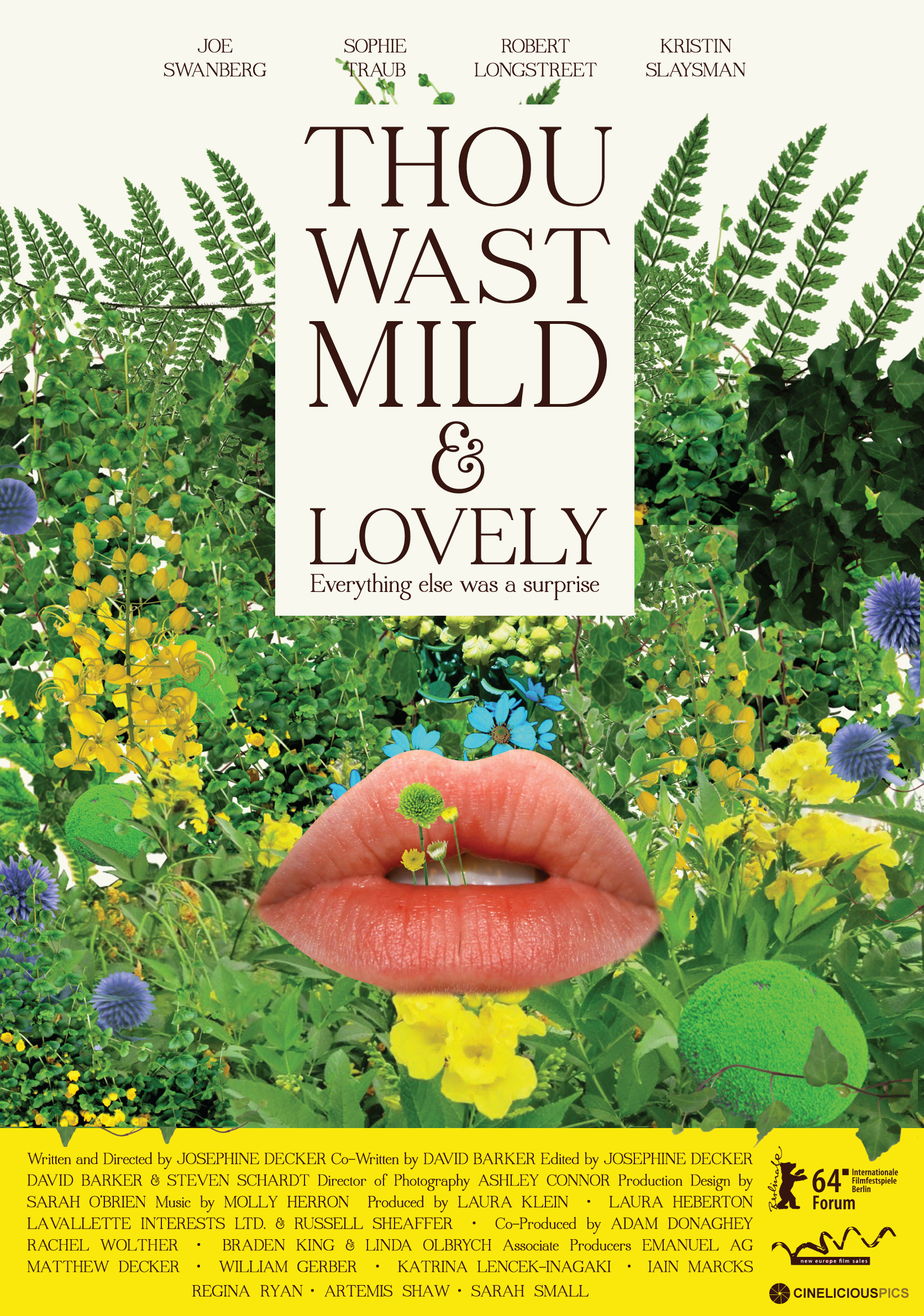
But then, Decker shifts from the gendered types to a more common core with Thou Wast Mild and Lovely. In a brief director’s statement included with the press materials Decker fearlessly lays her dark heart bare.
How do you steer a bucking bronco towards the truth? How do you let the dirtiest worms slither onto the page and not stand up in disgust? How do you let yourself be, and suffer the consequences? Ironically, what I did in writing and making this film is something that all of the characters in the film also suffer through. We are ugly, gruesome people inside. No one knows this but us.
What this statement and the film itself does though is force the audience to accept that they too are suffering in the face of our own ugliness. The film is a harsh reflection, far beyond the simplistic and rote evil power plays we expect from slasher films or even the torture porn genre, which only requires us to watch and be titillated by the violence onscreen. Decker offers up the mean-spirited Jeremiah (Robert Longstreet), his innocent daughter Sarah (Sophie Traub), and their lodger Akin (Joe Swanberg), a secretive man intent on keeping his desires and urges either in check or away from prying eyes, as a different collection of types for us. Here, she forgoes the epic and the mythic, instead downshifting to more human characters with a relatability that we, at first glance, would not choose to acknowledge because that would require exposing ourselves.
As a critic who has delved into the broad questions of torture porn, the horror (and Thou Wast Mild and Lovely is indeed a horrific tale) that Decker holds up before us is far more insidious than the mere sphincter clenching shock and awe that we encounter in the studio fodder that pops up in the multiplex or in the gross-out affairs of say something like The Human Centipede. She forces us to look at our secrets and own them, to embrace them, if only to ourselves – possibly the most difficult task of all.
Talk about perverse beauty, right? (tt stern-enzi)
 terrencetodd