
There’s a certain fascination with films that challenge us to insert ourselves into unfamiliar, and potentially dangerous, circumstances. In most cases though, the movies that we think of are those that want us to dreamily identify with a handsome hero (Brad Pitt fending off a zombie apocalypse, Leonardo DiCaprio on the hunt for crisis diamonds) or a pretty woman using her feminine wiles (Julia Roberts as Erin Brockovich) and it matter little whether or not these characters are based on real people or not, because they are idols, and somewhere along the way, their ideals get lost in the Hollywood shuffle.
But that’s part of the difference with the Laura Poitras documentary Citizenfour, which turns the camera on the exchanges between Poitras, reporters Glenn Greenwald and Ewen MacAskill, and Edward Snowden, the NSA analyst-turned whistleblower on the government’s programs to use and exploit telecommunications to collect information on the American public without consent (or our awareness of the actions). We learn, early on that Snowden chose to reach out to Poitras because she had already been the target of probes and placed on a watch list due to the subjects of her past films, and to her credit, Poitras never backed down in the face of such scrutiny. He recognized that to embark on such a perilous venture would mean surrendering any and all efforts to maintain or return to a normal existence and that he would need collaborators willing to join him along the tightening margins. Poitras would wield a camera in support, but the act would not be a passive endeavor.
Just as his task would be far from that of a mere tech drone working from a desk in obscurity. Snowden was on his way to becoming more than a whistleblower; he would be transformed into a spy, an enemy of the state, the subject of a manhunt the likes of which would seem like something out of a Bond or Bourne adventure (albeit minus the gunplay and hand-to-hand combat exchanges). It should be noted that the stakes here are indeed quite high. This is the stuff of conspiracy theory nightmares, not for the faint of heart or those with doubts about the current state of technological affairs.
Remember, we live in a virtual world where we keep all sorts of passcodes on our smartphones – banking, credit, customer cards for stores, photos – and we have seen how easy it is for individual and corporate systems to be hacked and information to be posted for general consumption. It is not hard for me to imagine that someone, somewhere is aware of the keystrokes generating this piece and the inevitable posting that will take place minutes from now. It seems meaningless, just another story on a film about Edward Snowden, but again, someone, somewhere who may not cotton to the notion of another piece written about this man or the people who worked with him, to expose the secrets of the NSA, well, who knows…
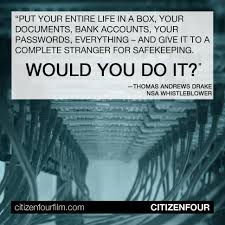
And I am far from a conspiracy theorist – that’s a rabbit hole akin to the wormholes of Interstellar. Enter at your own risk, and beware where (and when) you might emerge, if ever. But questions remain, looming over the proceedings, as you watch Snowden’s tale unfold. Would you be willing, in his situation, to do what he has done? To box up your life, a precious few belongings, and disappear, dash from country to country as a fugitive, an outlaw wandering on the outskirts of a dangerous periphery, seeking asylum from countries with records on civil and human rights that would seem incongruent with the American democratic system? But, in reality, is the American democratic system what we imagine it to be?
Could any of us be Citizenfour? Could we live up to the task?
Forget the dream of being Matt Damon, traversing the globe in a search for identity, with the skills of a super-assassin. In real life, Edward Snowden was a 29 year old programmer/analyst with barely enough scruff on his face to groom before he sat down in front of the cameras in that hotel room in Hong Kong with Poitras, Greenwald, and MacAskill. He was a kid, like we all were at some point, or maybe are right now. He was the kind of person I imagine my 16 year old daughter growing into one day, on her own, working and being confronted with knowledge that someone or some system is abusing a sacred trust. Would she do the right thing? Would I have done the right thing all those years ago, when I was his age, in the same situation?
The question remains. Would you? (tt stern-enzi)
 terrencetodd