
Thanks to the time difference, my blog posts have been a bit scattered. I’m in early morning screenings – starting around 9:30 am Munich – but of course, that means it is 3:30 am Cincinnati time and even when I get a mid-morning to afternoon break, like now, it is still before 9am in the Queen City. It has taken more time than I expected settling into the time displacement. In terms of the coverage, it’s not that I’m writing exclusively for the Porkopolis crowd (I have been graced with readers from across the globe for this little adventure and I thank you all for checking me out), but well, I am and I want to share the whole hog with you.

Meret Becker (Coco) and Jeanette Hain (Patti)
Which, for this third dispatch, means finally getting around to some of the German film fare at the festival. While I have thoroughly enjoyed the international selections, until yesterday I had missed out on films from the home country. The morning kicked off though with Lügen (Lies) from Vanessa Jopp (Film Studies at the University of Television and Film in Munich). Lügen, from its catalogue blurb, sounded like a rom-com pitch with dramatic touches thrown in for a sense of edginess. Several interconnected characters cross paths, centered primarily around a bohemian painter named Patti (Jeanette Hain) and her best friend Coco (Meret Becker). Patti’s challenging art and flighty lifestyle put her at odds with Coco, a dentist on the verge of marriage to a struggling real estate agent. The assorted crew flits around these two and thematically, it is all about either the lies we tell, big and small, or the things we keep hidden from those closest to us.
Jopp’s film boldly walks down the more dramatic path, rather than toying around with broad comedy as one might assume (not that there aren’t enough laughs to engage the audience). Lügen isn’t about crazy situations though or cheap humor; there are some hard truths to be revealed here, rooted in the characters and their all-too human flaws. The performances work better in individual scenes and moments though because, when taken as a whole, it is easy to guess where certain threads will unravel. What I found fascinating with the film is how it approximates the sense and sensibility of an American indie, much moreso than a Hollywood multi-player rom-com romp (Valentine’s Day or New Year’s Eve, for instance) or even a sentimental journey like Love, Actually from the Brits. Jopp doesn’t fear exposing the brittle nature of her characters, and we are better for it. Far from perfect, but worth the trip, in the end, since it refuses to offer pat resolutions, for the most part.
My second sampling off the German menu came this morning with Philippe Leinemann’s crime drama Wir Waren Könige (The Kings Surrender). At first glance, as the opening frames draw you in, the film feels like a cousin to the cool machismo of Michael Mann, albeit minus the recognizable star turns (no Tom Cruise, Colin Farrell, or Johnny Depp to distract us), although it wouldn’t be difficult to slot them into the character types as we get to know them. A Special Crimes Unit prepares to enter a dealer’s home. We’ve seen the seedy dive before, complete with drugged out thugs laying about, a girlfriend talking smack, and the dealer spitting flames into the phone as he attempts to arrange a meet. Things go awry, an officer goes down, along with a pair of thugs, and the dealer slips through the cracks, which means the Special Unit is out for blood. And before you know it, you might think you’re in the recent David Ayer flick Sabotage with Arnold Schwarzenegger, Sam Worthington, and Joe Manganiello, but you would be wrong, dead wrong.
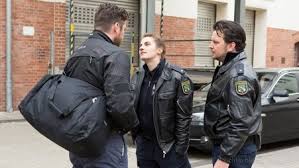
Forget black and white – its all grey here
Leinemann makes a strong pivot, early on, piling his juiced up rogue cops into a local bar with a crew of would-be thugs and neighborhood ruffians. They clash, but are forced into an unlikely peace, for the night (involving drunken bowling of all things) that highlights the connections between them. The cops live by a harsh code of justice that allows them to believe the ends justify the means, while the thugs look out for their own, and seem to be in position to make far different choices; ones that could result in them becoming much like the cops.
What this sets up, in narrative terms from this point forward, is a film that comes to resemble a truncated episode of The Wire, especially in the shifting back and forth between the downwardly spiraling Special Unit and the criminal-minded crews on the street just trying to survive and protect their own. For viewers, the plot is straightforward without seeming merely simplistic, which is good because for the characters, its one big ball of confusion and compromises with no resolution. Choices are made and the consequences smash and grab everyone. There are no heroes, Leinemann says, in this game, but audiences would be wise to acknowledge, going in that The Kings Surrender is also not an intricately plotted chess match like Boaz Yakin’s Fresh from ten year ago. There is no master plan, no strategy to win out here. Just life and a whole lot more moves to be made.
German film is meaty and sticks to the ribs, satisfying without too much extra spice to muck up the natural flavor.
 terrencetodd