
Tags
About Last Night, Brooke Shields, Demi Moore, Endless Love, Joel Kinnaman, Joy Bryant, Michael Ealy, Rob Lowe, Robocop, Steve Pink
tt stern-enzi
Endlessly Getting it Wrong
I was ten years old at the start of the 1980s, already a fledgling movie nerd; credit or blame for that solely rests at the feet of my mother, who gave me the best rewards of time and love when she would take me to the movies. Sometimes, the excursions came on days when she would pick me up after school and we would head downtown to the Plaza on Pack Square in Asheville, NC, or maybe we would select a weekend for our movie dates, a lazy Saturday or Sunday afternoon. It didn’t matter to either of us. She would let me pick the movies and I think, even at that stage, I already had a sense of what was age appropriate. I used to sit and stare at the album covers of the soundtracks from the blaxploitation classics with Pam Grier’s beautiful ‘fros and the fur collars or black leather jackets of the Macks, knowing that I wasn’t ready for those shows, but I dreamed up my own scenarios of what took place in those stories, waiting patiently for the day when I would be able to see them on my own.
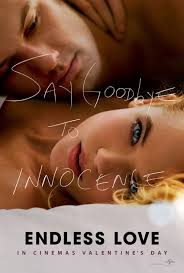
The times, they were a’changing though. The 1980s gave us several key transformative touchstones. Brooke Shields. MTV. Home Box Office. Brooke Shields. VHS. Did I mention Brooke Shields? I’m laughing at myself as I endlessly insert Brooke Shields into my greatest hits of my decade because at the time of the release of Endless Love, I wasn’t even allowed to see the movie, and by the time it helped to kick off the early cable distribution model, we didn’t have cable. A few of my lucky friends beat me to the punch, which meant they got to see what I imagined was an endless reel of love scenes, further hyping the movie and my desire to “invite” myself over to someone’s house for a sleepover and a screening of it.
Of course, I ended up underwhelmed by the whole affair once I finally saw it. The movie worked far better in my imagination, which in some ways is the perfect summation of the new version with Gabriella Wilde (in the Brooke Shields role) and Alex Pettyfer as her eternally fated paramour. Director and co-writer (with Joshua Safran) Shana Feste hasn’t so much remade the original, as concocted what feels like a Nicholas Sparks adaptation without any of the juicy dramatic kick that Nick Cassavetes (along with Gena Rowlands, James Garner, Rachel McAdams, and Ryan Gosling) brought to The Notebook. Blank vacancy behind the eyes of your supposed star-crossed lovers is not the recipe for passion and the PG-13 skittishness over anything remotely resembling sensuality means that teens today will certainly have to look elsewhere for reflections of desire that have loins-stirring resonance. I can’t imagine a pre-teen crowd developing the same degree of anticipation for the 2014 edition of Endless Love that I had for the 1981 version, and that has little to nothing to do with the notion that thanks to technology, we have a heightened immediacy built-in to new releases. Movies have to have some sense of hopeful expectation, the ability to inspire endless fantasies, and not just more of the same lackluster, passionless romance that we, now sadly, call love.
The Ghost in the Machine of the “New” Robocop
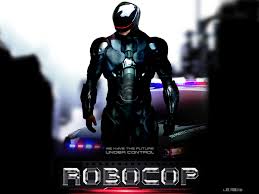
I’m willing to go with the “dead or alive” Joel Kinnaman stomping his way through the remake of Robocop. The original, from Paul Verhoeven, arrived on screens with a campy splatter of violence. Scenes were sopping wet with buckets of fake blood. I recently re-watched the movie to remind myself of its charms, which I recall discussing in detail in an English class during my undergraduate years that used film as text. We explored the many evolutions of identity that Peter Weller’s Alex Murphy experiences throughout the narrative, how Verhoeven starts things off by not allowing us to even see the new officer as he strides through the station, and then repeats the same cycle again, later on, once he has “died” and returned as the new robot cop. That movie is about a series of endless repetitions for the character, as he keeps living through moments again and again, rebooting experiences until he gets things right.
It would have been interesting if the new film had more closely followed that notion. Instead, José Padilha and his current screenwriter Joshua Zetumer (with credit also extended to the original team of Edward Neumeier and Michael Miner) invest more time grounding us in the humanity of Alex Murphy, which is well-served by the slinky grace of Kinnaman who brings a familiar charm and potency to the role for those of us who recognize him from his work on the AMC detective series The Killing. He embodies the intensity of a driven professional with more than a few trace elements of humor in his DNA as well. The choice has been made to allow us to see more of his face throughout, a smart move, since he has a twitchy energy in the presence of other performers, like Abbie Cornish as his wife Clara, Michael K. Williams as his under-utilized partner Jack Lewis, and Gary Oldman as Dr. Dennett Norton, the man who inserts Murphy’s ghost into the machine. The human interactions and Murphy’s strivings to hold onto that essence of himself would have been fascinating to watch, but the movie updates things with a political debate about the use of robot drones in war zones and the question of whether or not we should allow them to patrol the streets of American cities. As portrayed here, it is a debate as facile and pathetic as any we are currently waging in our news cycle. And, because this is supposed to be an action movie, Robocop comes packed with a parade of visual cues and samples from the latest and greatest tin men of our times (Elysium, Judge Dredd, Iron Man, what will probably be tapped into for the upcoming onslaught of Ultrons in the next Avengers movie).
The machines have already won. They control the studios creating the content we consume. Welcome to the real ghost world.
Loving Laughs: Shifting the Focus of About Last Night
Talk about daring.
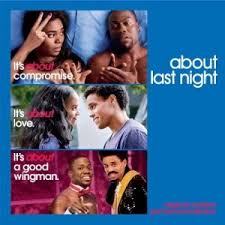
There’s a scene during what amounts to a montage capturing the whirlwind affair between Danny (Michael Ealy) and Debbie (Joy Bryant), the respective boring best friends of Bernie (Kevin Hart) and Joan (Regina Hall), the far-more tempestuous and combative lovers here, where they sit, wrapped in bed sheet with takeout carefully scattered on the coffee table, while they watch and debate the merits of the original About Last Night… as a movie for guys or a chick flick. It is ballsy having this new couple watch (and allow audiences to see) that earlier Danny (Rob Lowe) and Debbie (Demi Moore) locked in similar romantic bliss, because in some ways it comments on how the fates and the scripting/execution here – from screenwriter Leslye Headland and director Steve Pink – have conspired to shunt the new Danny and Debbie to the margins of what should be their own story as a couple. Upstaged by the past (this weekend is certainly making an aggressive argument for the 1980s as the Greatest Decade of Pop Culture ever), and the fevered antics of their comedic co-stars (for weeks now, everyone talking about this film has framed it as the latest in the full-on blitz from Kevin Hart, currently the hardest working man in the multiverse), Ealy and Bryant don’t seem all that bothered by the situation. They politely and agreeably hit their marks and present their pretty and just-so compatible faces to the camera like models who could be on the verge of supermodel status, but lack the opaque ambition to make their dreams come true.
What they need is a bit of the balls that Steve Pink displayed when inserting Lowe and Moore into the mix. With that in the tank, they could have made About Last Night about something much more intriguing.
 terrencetodd