
tt stern-enzi

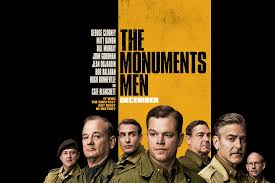
As a critic attending a Cincinnati public screening of The Monuments Men, an investigative angle arises that rarely takes shape during most of these events; its the kind of challenge I cannot let pass me by. Monuments Men is a George Clooney film and Clooney is a hometown hero. Anytime the guy releases a movie, people around here have something to say because rarely do we get to feel like an integral part of the moviemaking machine, let alone the sense that we might actually have a hand on the wheel. But Clooney gives us that stake.
The problem, critically speaking though, is a breakdown emerges because, while listening in, it becomes painfully obvious that we are rarely talking about the same thing (at the same time) when we talk about George Clooney. Everybody loves George Clooney movies, but once the debates begin, the definition of a George Clooney movie scatters to the four winds.
“What’s your favorite Clooney film?”
“It’s a different choice, but I liked The American.”
“Didn’t see that one. I loved Ides of March though.”
“I forgot about that one. You know, I was fine with what he did in Gravity, but there are 20 other guys in Hollywood who could have done that. And Leatherheads was atrocious.”
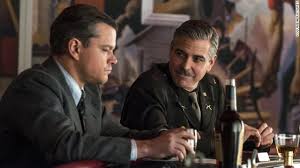
Personally, I’m a fan of his collaborations with Steven Soderbergh. In terms of stylistic variety and consistency of outcome (competing sensibilities), the pair had an intriguing run of engagement that harkened back to the golden age of the movies, and possibly served as a model for new generation of director-actor team-ups (Scorsese-DiCaprio, Refn-Gosling, McQueen-Fassbender). Hollywood wanted, and worked quite hard in its way, to make him a cross-over star. He clawed his way through the television ranks, but by the mid-90s, with One Fine Day, From Dusk Till Dawn, Batman & Robin, and The Peacemaker, we were getting mushy cafeteria serving-table Clooney dishes rammed down our collective throats.
Soderbergh, like a talented chef, tapped into the obvious charm and flavor profile of George Clooney, to create a spiky treat from Elmore Leonard’s Out of Sight – the recipe here merely a twist of the formula of The Underneath from a few years prior and one that he would tweak again by adding an even more seasoned main ingredient (Terence Stamp) in The Limey. I appreciated the idea of Clooney as a bank robbing careerist, a rogue with a code of honor and ethics that wouldn’t allow him to use a gun. His mind and his considerable charms were weapons enough to do the work. Having read a bit more Leonard in the ensuing years, I find myself shoehorning Clooney somewhere in the mix because Leonard’s fast-talking criminals and lawmen alike all have some Clooney-esque trace about them, even if its only in their heads. They dream, and if you’re working to make those dreams real, who’s to say you can’t work on being more like Clooney?
Of course, the Clooney-Soderbergh team continued to dream too and what seemed like the biggest, craziest dream of all was to tackle Stanislaw Lem’s probing science fiction novel Solaris about a psychologist commissioned to investigate what happened to a team of astronauts in a space station above a mysterious planet, which director Andrei Tarkovsky adapted back in 1972. Again, Soderbergh employs our expectations of Clooney’s charisma – some might argue even more than Clooney himself – and cuts away all of the static tension of the original, reducing the narrative down to what is, essentially, a one-man show. The spotlight rests solely on Clooney’s character and what matters most to him.
This collaboration has produced a number of signature Clooney moments (some, like the Ocean’s Eleven series have strayed, quite wonderfully into a much more lighthearted mirror-gazing mode that sends up old Hollywood conventions) and served as a blueprint for other directors to follow. The aforementioned The American, from director Anton Corbjin, dials down the charm, but retains enough to simmer in the film’s European milieu of old-world assassins and dry romantic longing. On the opposite end of the spectrum, the Coen Brothers cast him in O Brother, Where Art Thou? and jacked up the golden leading man factor exponentially. Clooney can play it either way – broad as the side of a barn or tight and lean as new elastic – and maintain his hold on us. He’s won an Oscar (in 2006 for Syriana) for a supporting performance that, for many of his casual fans, might as well have been a lead, because it is likely that if I had asked people waiting around for The Monuments Men to start, they would not have remembered anything about the film other than the idea of Clooney being in it.
But I’m still not quite at the issue of The Monuments Men. I remain, somewhat stubbornly, stuck on that snippet of conversation I included and the critical dilemma it lays out. It should be noted that I’m a fan of George Clooney in other people’s films. I believe other directors exploit his skill set to greater effect than he does for himself. That is a curious distinction that sets him apart from, say, Ben Affleck, a Hollywood type, much like Clooney, who plays the filmmaking field, so to speak. Yet, in Affleck’s case, he’s hit or miss as a performer in the work of others, while he seems to have the uncanny knack for knowing just how to use himself as an actor, when he’s at the helm. I have been far more impressed with Affleck’s acting in The Town and Argo than anywhere else, and I’m on record praising his directorial work, which, in three films so far, has shown marked growth with each outing. When I think of Affleck, I am drawn to his films as a director rather than those that rely primarily on his acting.
Say the name “George Clooney” though and I latch, first, onto the performances I’ve mentioned, quickly followed by the recognition that he’s a solidly composed director. He earned Academy Award writing and directing nominations for Good Night, and Good Luck, just his second feature film behind the camera. Confessions of a Dangerous Mind, his first time in the big chair, had a jazzy rhythm, smart and jagged, with a good eye. Leatherheads was a throwback that wanted to be like a Soderbergh-Coen Brothers diversion, while Ides of March was Clooney playing politics. And now, with The Monuments Men, we get more of the liberal worldview, less overtly politicized, but climbing up on the old soapbox for an old-fashioned sermon on the value of doing the right thing. The film is about preserving art and Clooney’s going about a bit of preservation of a similar way of life, because he’s knee-deep in hanging onto a sense of that bygone charm being all you need to carry a film. The Monuments Men is Ocean’s Eleven brought to you by the Greatest Generation and there’s a solemn speech or toast just around the corner of every frame. He wants to honor the real life efforts of those who sacrificed to keep this cultural legacy alive, but there’s precious little “real life” to be found in the movie. There is only nostalgia.
Which is sadly, what is starting to take over my impression of George Clooney. I want to be the first to stand up and fight for the Clooney I see in the works of others, those whose vision is not rose colored. I want to engage in pitched battle over George Clooney the actor versus George Clooney the director. I want to care enough to speak up about him, to clarify what it means when we talk about George Clooney, but I suppose I want George Clooney to give me a reason to do so.
 terrencetodd