
tt stern-enzi
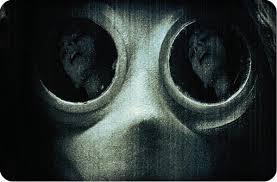 So much of critical response in today’s fast click/twitch world relies on release dates, because there is a game being played, an undated viral version of Trivial Pursuit that spins wildly based on the last (or more specifically, the most immediate) reference that can be called to mind. We can’t look too far back; our archives aren’t that complete. We know what we’ve experienced and most of that had to have been familiar, recognizable or we wouldn’t have added it into our memory banks. So, quick, what does the image at the beginning of this post remind you of?
It is not monstrous, not a primal frightful image, but for those quick draws out there scrolling through the “horror” tab, I’m willing to take The Purge or You’re Next as answers. There’s likely a player or two out there who thinks there might be extra credit for digging further back for The Strangers, and I suppose I owe you that one too. You don’t know who’s behind the mask, but you know they’re coming for you. They’re breaking the sanctity of your home, your most intimate spaces where you keep a secret or two, something you and your partner refuse to speak of in public, and you best be afraid, very afraid because it is that secret, which will be used against you.
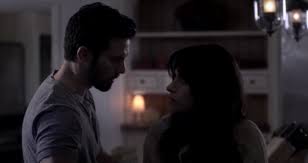
Static, a new release (arriving on Blu-Ray 3D + Blu-Ray + good old fashioned DVD) this week, travels down this well-worn path. It is yet another family under siege. A relatively young couple – played by Milo Ventimiglia and Sarah Shahi – wanders around their tragically majestic home in the woods. Hubby’s a writer who just finished his latest novel, while his wife pops pills and broods with sunken eyes overflowing with a river of tears. There’s a tiny gravestone nearby marking the resting place of a tiny life – their young son, which means they silently blame themselves and each other, and the question becomes, what will break them free of their stasis, the grief that encases them?
What, indeed?
I love screening films like this for an audience comprised on students in WatchWriteNow, the independent after school film club I facilitate at Lighthouse Youth Crisis Center. The kids know the tropes and the score, but they watch with a hunger; they want to be the first to figure this one out. What’s the twist? Who’s going to die first? Which one of these fools is going to do something dumb (that only happens in one of these movies) first? They shoot first and straight with raw, unfiltered honesty that allows us to discuss other things along the way. Race is an easy target. For instance, the dumb move usually comes from a white character – the white guy who wants to split up or the white female who runs and falls on cue, even though you know she will survive (not always) – and the kids, a diverse mix of black and white, have a hard comfort when it comes to talking about race. They have had lives with so much offense that race generally isn’t at the forefront of their concerns. They tend to know what really matters, what buttons shouldn’t be pushed amongst them.
But, I have to admit, I like it even more when movies surprise them. Confusion is likely a problem for their teachers in traditional classrooms. They might tune out, seek to escape, or become disruptive. But not with me. When I close the blinds and turn off the lights, the visual text tends to strap itself around them, refusing to let go. Sometimes they struggle and squirm against its constraints, but it conforms to them, gently easing them back into its clutches.
New releases on DVD, especially films that never enjoyed regional release in theaters, with less familiar lead actors slip past the defenses. And, in the case of Todd Levin’s Static, which seems to inhabit a curious narrative limbo – not a multiplex feature but certainly, clearly operating above the typical straight to DVD/cable television product – the film lends itself to collected viewing on a smaller scale. It entices viewers to lean in, to talk, to debate. It encourages the sense of gamesmanship, that Trivial Pursuit-style rush of references. Better still, when it’s twist emerges, everyone’s waiting for it, excited to see how the narrative has played them. It inspires a sense of fun that overcomes the competitive drive, the need to take the experience too seriously. Here’s a hint – the final switcheroo is another direct and obvious movie reference that, when all is said and done, has just the right amount of sentimentality to match the set-up.
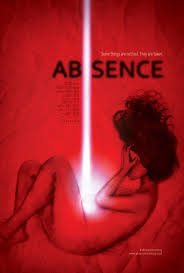
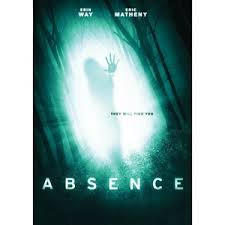 Things went so well earlier in the week with Static, I capped off a thematic (families in peril) double-feature for my WatchWriteNow crew. Sticking with the new horror genre stuff, I screened Absence, the debut feature from co-writer & director Jimmy Loweree, which meanders down the found footage path as it details the story of Liz (Erin Way), a first-time expectant mother with a loving and devoted husband named Rick (Eric Matheny) who wakes up one night during her seventh month only to discover that the baby in her belly has mysteriously disappeared. After careful evaluations by medical staff at the local hospital, Liz and Rick find themselves suspects in what becomes a child disappearance. The community labels them “child killers” and the questions never cease, so Liz’s little brother Evan (Ryan Smale) and Rick decide on a getaway, a retreat to a cabin in the woods where the family can quietly heal together. Of course, thank to Evan’s status as a graduate student in a film program, they must do so in front of the camera.
Okay, so, once again, we’re playing around with genre references – Paranormal Activity meets The Fourth Kind – but there is real humor and humanity (albeit somewhat forced at times due to the acting) in the execution because Loweree focuses on the mundane. His story feels like the ambling process of recovery, an overcoming of guilt and grief that happens like a spring thaw. Ryan tries too hard to make Liz and Rick laugh, but you appreciate his effort; it stems from love and concern. When Liz first smiles at one of his lame jokes and then can’t quite contain the chuckles that follow, we find ourselves sharing that with her. There are silly pranks, meals together, and along the way Evan even picks up Megan (Stephanie Scholz), a recent Brown graduate who settles him a bit, completing him and the character foundation of the story.
But we still want, and need, to know what happened to Liz and Rick’s unborn child. The movie teases us with static and the occasional case of the random shakes. Liz suffers from nosebleeds that seem to get worse each time. There’s also a mysterious light that flickers at night and seems to disrupt electronics in the vicinity. What does it all mean? We want to know, but the characters and the everyday stuff gets in the way, distracting us, until…what should be a most unsatisfying end. The camera goes crazy. Liz disappears one night. The guys fight and make up and find her and find…
There are no answers, at least not for them, and in all the ways that count, there aren’t many real answers for the audience either. Keep watching during the credits for an extra sequence, just more nothing. Yet, watching Absence with this class reminded me of the power captured in these communal viewing experiences. Alone, I would have railed at the stunning lack of closure, how Loweree strung us along with no real payoff, much like the Paranormal franchise has done. But, here, it didn’t feel right to do so because I had enjoyed the screening and oddly, so had the class. The watching and waiting together bonded us, to each other and to the characters. We liked Evan and Rick, felt sorry for Liz. I can’t say I ever felt all that much for the sisters caught up in the Paranormal Activity hijinks or their families. The absence created at the end of Absence left me with fond feelings…and no real desire for another movie that certainly wouldn’t answer any of the lingering questions. I’ll stick with what I didn’t get here. Thank you very much and I know my students feel the same.
 terrencetodd