
by tt stern-enzi

Richard Donner’s Superman movies made us believe that a man could fly, be impervious to bullets, and be super while also more than a little goofy all at once. That Superman (Christopher Reeve) was less a symbol of American ideals – although he never refrained from grabbing hold of the nearest flag and flying it around for all to see just ot prove his bonafides – than just a ‘good’ guy trapped in a super body.
Tragically, a couple of the bodies that have framed and encapsulated the Superman persona onscreen have forever succumbed to a flawed conception of invulnerability and the inevitable frailty of our humanity. George Reeves was shot dead on June 16, 1959. Christopher Reeve rendered paralyzed after a fall from a horse. The spirits of these men may have been super but their bodies were sadly all too human.
Something different emerges from Man of Steel, the latest attempt to bring Superman to life. This time out, the film focuses on masking or hiding the ‘super’ aspect of this character, which of course leaves us with the man. And here, Clark Kent (Henry Cavill) struggles to reconcile his humanity with the power and destiny that makes him something more. He’s not of us and yet, he becomes susceptible to treatment that identifies him with the least of us. He’s bullied and marginalized. His human father (Kevin Costner) advises him to remain in the shadows, to deny his otherness, which only re-enforces the fact that he’s not a man.
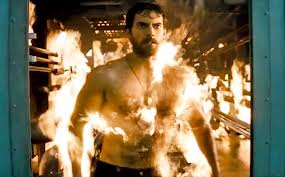
But it instills in him a longing to be human to embrace this part of himself. He identifies as a child born of both Krypton and Earth, unwilling to deny either side of himself, but any social minority will tell you that at some point, you are forced to choose or the choice is made for you. The fundamental question remains though, is he human? Does he, as Professor Cornel West notes in his definition of what it means to be human, struggle daily in the face of inevitable death?
Curiously, the answer in the film is possibly yes. He confronts death, not his own, but that of both of his fathers and others (ultimately even using his own considerable force to take life, unseemingly in supermen of virtue). Jor-El (Russell Crowe reliving his Gladiator days of old), his natural father (Matrix-free on Krypton), imagined him a god among us, and so it would seem that Pa Kent too subscribes to that notion, but he also sees fit to bestow humility in Clark/Kal-El.
We can easily ignore the Christian overtones in this retelling of the great story; we have seen and heard it all before. Clark is 33 years old by the time he exposes himself to the world, offering himself up as a sacrifice to stop General Zod (Michael Shannon) from killing mankind, although that’s what he has always intended, in his blind fateful course to rebuild Krypton from the ashes of another world with the core DNA of all Kryptonians placed in Kal-El by Jor-El.
He learns that he is the embodiment of hope – that symbol on his chest is not a mere ‘S’ – but for whom? That is the choice he must make and he, for now, has embraces humanity. Does that mean he wants to be one of us? And do we want to count him among our ranks?
Don’t ask Congress.
 terrencetodd
This is the reality of a man with a damaged spinal cord and a mind that refuses to be imprisoned by severed nerves. Never once has Christopher Reeve dreamed of himself wheeling down the hall of a hospital in his wheelchair. Never once has he dreamed of arms that will not reach, of legs that won’t run and jump at his whim. He dreams the dream of a man equipped with a healthy, vibrant body that was his before 1995. He dreams the dream of a man who runs and bikes and sails. It the dream of things that once were and the fantasies of the things that will be when he is whole again, maybe next year, maybe the one after that or sometime down the road. But soon the nightmare will end and the dream will re-materialize.