
by tt stern-enzi
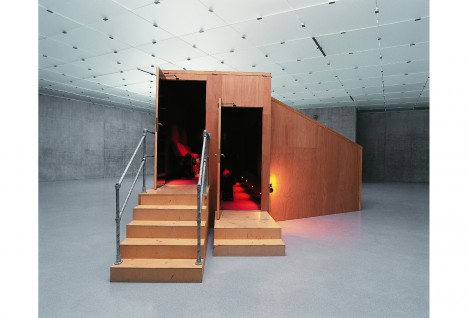 Quite possibly the best film I caught during the opening weekend of the 37th Cleveland International Film Festival wasn’t even a film screening at the festival. I’ve been haunted by an experience I had just a few short hours before departing Cleveland, last Sunday, at the Museum of Contemporary Art (MOCA), the last official stop on the press tour for Indie Cleveland. My companions and I were in the care of MOCA curator, David Norr and the first installation of our guided tour was Janet Cardiff & George Bures Miller’s The Paradise Institute, a unique collaboration that, from its unassuming outer appearance would seem like an out of place, unwrapped gift. It is a plywood structure, bare and unpainted, occupying the main white space. What have we here, I wondered, refusing to wander over to the sidewall where a brief introduction may have given me some clue as to the construction’s purpose and function. No, I knew it was best to simply wait for the chance to see what was inside.
Two doors, side by side awaited, and upon crossing the threshold, two rows of plush seats, vintage movie house seating that approximated the feel of an old-fashioned balcony. But there were individual headphones attached to each seat. And then, once you’ve taken a seat, straight-ahead, just a short distance away, was what appeared to be the lower level of this theater, all in miniature, complete with a small screen, but the scale of it all played tricks with your mind and eye. Were you a giant who had wandered into this tiny landscape or the world you knew simply compacted in on itself, while you remained unchanged?
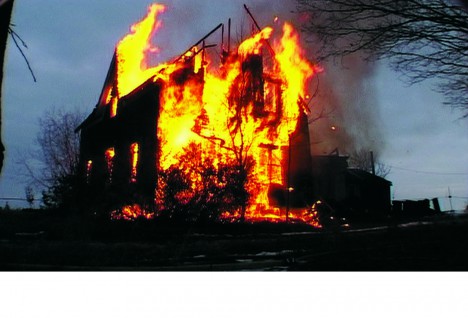
The film, a lightly etched narrative that recalls Blue Velvet (from David Lynch, the master of visual off-kilter kink) and Suture (the perceptual head-scratching debut from the writing/directing duo of Scott McGehee and David Siegel that celebrates its 20th anniversary this year), each in their crisp elegance and undeniable weirdness, is just part of the attraction. A patient’s eye fills the frame one moment, then a nurse enters and displays an unusual bedside manner, and later a structure aflame teases us. The whole affair is about titillation, but it never veers into overtly lewd expressions. There is freedom for the mind to wander.
Yet, in addition, viewers will find themselves submerged into the experience of a live movie house, with relief-based sensory details that the technocrats in Hollywood dare to imagine that they present to us with all of their vaunted CGI and 3D capabilities. Yet, here, as you overhear the concerns of a woman a few rows back who believes she has left a stove burner on at home, the munching of popcorn (which your mind tricks you into believing that you can even smell the fresh butter too). There’s even a ringing cellphone, it is an older model, no hip ringtone here. That, of course, is because The Paradise Institute was conceived and first exhibited back in 2001 (at the Venice Biennale, where Cardiff and Miller represented Canada and won the Golden Lion Award), before the pervasiveness of smartphone culture, but that is what makes the project so prescient.
The experience reminds you of what it means to go to a movie house, what it means to share in this communal process. It is about film and what surrounds the film. As a work of art, what occurs for viewers is performative, but it drops us into the performance sphere; a space we are seemingly in the process of abandoning for the virtual pleasures of solitary streaming screenings. With movies following us from screen to screen around our homes – as we leave the main viewing space to dash off to the bathroom or to grab our own concessions or to make sure we didn’t leave the burner on in the kitchen when we got that snack a few minutes ago – we’ve given up on the notion of settling and tuning in for an uninterrupted experience. It is funny though that The Paradise Institute asks us to consider the heightened levels of “interruption” we’re comfortable with now.
Of course, this could just be the musing of a grouchy critic longing for a period that we’ve been transitioning out for for years now. Norr, at some point, after we had moved on past that little movie house, commented that “meaning happens” in front of any piece of art. The implication isn’t new or revolutionary. It simply means that through our experience in the face of the work, we discover “meaning” or “connection” for ourselves. I love the idea that The Paradise Institute is there to offer a reflection for those of us willing to continue venturing out to movie houses just what the experience is all about. And, at some point in the future, it will be a fitting reminder of what we’ve lost, when we’re no longer together in the dark.
The Paradise Institute (March 16 – June 9, 2013). For more information, visit http://www.MOCAcleveland.org.
 terrencetodd